CAMPAIGN "BUCKLE UP!"

According to research conducted by the State Automobile Inspectorate, only half of the Russian population always use their seat belt. For back seat passengers, the figure is considerably lower, at just over 10%.

The campaign objective is to explain to the entire population of Russia that wearing a seat belt is essential to protect one’s own life and the lives of one’s nearest and dearest.

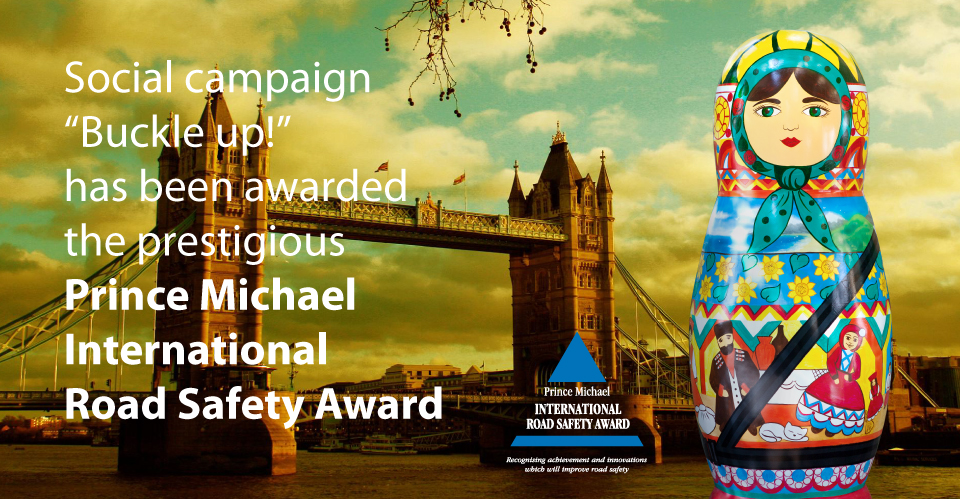
The main campaign image is a matryoshka doll wearing a seat belt. The matryoshka is a symbol that transcends the very diverse traditions and cultures in the world’s largest country, just as roads connect people, cities, towns and villages, unifying Russia economically and socially.


Opinions

Comments and remarks of renowned journalists, writers and public figures on the topic of the driving culture. Our experts and authors are resolute that respectful behavior implies high safety standards

Road Safety Russia

The Matryoshka will symbolise safety on russian roads

The State Automobile Inspectorate announces a new nationwide public awareness campaign, “Buckle Up!”. The campaign, which will last until July, is being run in partnership with the Russian Association of Motor Insurers and the NGO Road Safety Russia.

Surveys of more than 50,000 people have revealed that only half of the Russian population always use a seat belt. Furthermore, even although back seat passengers are just as vulnerable in the event of an accident as the front seat occupants of a vehicle, the Russian Public Opinion Research Centre (VTsIOM) has found that only 17% of back seat passengers always use their seat belts.

The campaign’s main objective is to explain to road users that the use of seat belts is mandatory for all drivers and passengers, including back seat passengers. Over the years, numerous tests conducted both in Russia and abroad have shown seat belts to be effective in the event of a road accident or sharp braking.

Unfortunately, drivers and passengers in Russia today are failing to give seat belts due attention. Many road traffic deaths could have been prevented had the vehicle occupants been wearing seat belts. Studies show that seat belt use by drivers and passengers reduces the likelihood of death by 50%.

The symbol of the “Buckle Up!” campaign is the matryoshka, Russia’s most famous and recognisable image. The matryoshka is a symbol that unites the diverse traditions of the inhabitants of Russia, just as roads connect people, cities, towns and villages, unifying Russia economically and socially.

During the campaign the matryoshka will remind people of the rules of the road through competitions, lessons in schools and nurseries, and educational events and...

Full article
Road Safety Russia

Personal responsibility could be the main guarantee of Road Safety

Under the Russian Federation’s Traffic Regulations, the use of seat belts is mandatory for drivers and all passengers, including rear seat passengers. However, while front seat occupants have indeed started to buckle up, rear seat passengers seldom use their seat belts. To identify the reasons for this, the Road Traffic Safety Department of the Russian Ministry of Internal Affairs has been conducting an online survey of Russians on the use of passive safety features in vehicles. The previous question, which was posted on 6 February, ascertained the respondents’ views about what could encourage both front and rear seat passengers to use seat belts.

In the last seven days 6 532 people took part in the survey. The absolute majority, 3 788 respondents (58%), said that the main reason for using seat belts is awareness and understanding of personal safety. The other respondents expressed the following opinions: 768 respondents (12%) believe that tougher penalties could resolve the problem of the non-use of seat belts; 1 239 (19%) think that only a personal experience of a road accident will teach people to follow the rules; and 737 (11%) said that increased oversight by the Road Traffic Safety Department could increase the percentage of drivers and passengers who use seat belts.

Going by the survey results, Russians do not believe that increased oversight by the Road Traffic Safety Department and harsher punishment would improve compliance with the regulations on seat belt use. The respondents said that the main factor was awareness and understanding of personal safety, i.e. one’s own standards of behaviour and responsibility. TheRoad Traffic Safety Department intends to address this issue, together with the...

Full article
The Guardian

Life and death on the world's most dangerous roads

More than 1.2 million people are killed on the road every year – and more than 20 million are injured, according to a World Health Organisation report published on Thursday.

This makes road accidents the eighth leading cause of death globally – comparable in impact to communicable diseases such as malaria – and the WHO estimates it could rise to fifth in the rankings by 2030 unless action is taken.

Road traffic injuries take an enormous toll on individuals and communities as well as on national economies. Middle-income countries, which are motorising rapidly, are the hardest hit.Dr Margaret Chan director general, World Health Organisation  

Three-quarters of all road deaths are among young men – and road accidents are the leading cause of death for 15- to 29-year-olds.

The WHO's Global Status Report on Road Safety 2013 found that 27% of global traffic deaths are among pedestrians and cyclists – vulnerable road users who have been neglected in transport and planning policies. In low- and middle-income countries the figure is closer to 33%; in some, it is as high as 75%.

Margaret Chan, director general of the WHO, said the number of road deaths was "unacceptably high", while injuries "take an enormous toll on individuals and communities as well as on national economies". Low-income families are hardest hit by medical costs and lost wages.


Dealing with deaths and injuries on roads costs billions of dollars each year (pdf), taking an estimated toll on low- and middle-income countries of 1-2% of economic output – a total across those countries of more than $100bn a year. Middle-income countries, particularly in Africa, where car use is rising,...

Full article
Natalia Agre
President of the NGO “Road Safety Russia”

Who will save our children?

Very often it’s hard to determine who is to be blamed for a road accident and who is innocent. Sometimes a pedestrian runs out to cross a carriageway in a wrong place or a driver exceeds speed limit or a passenger doesn’t fasten a seat belt. But among the road users there is a group of people who can’t be accused of anything. They do not bear any responsibility for themselves as yet: they do not decide what speed to drive at, whether to fasten or not, they know nothing about the traffic light signals. We mean child-passengers whose lives totally depend upon other people.

Mrs. Natalia Agre, president “Road Safety Russia” public organization.

The Road Traffic Safety Department at the Ministry of Interior of the Russian Federation has published the road accidents’ statistics for 2012. According to the report 514 child-passengers were lost in road crashes - a 5% decline as compared to 2011. Translating it from the terms of figures we get 27 saved child lives. Not few indeed!

If the downsizing of child-passengers’ death toll continues at the same pace the problem will be solved no earlier than in 20 years. And how many kids will be killed on roads for this period? It’s a sad rhetorical question. It’s up for the adults to prevent tragedies but drastic measures should be undertaken right away. Three things must be done to reach the set goal.

The first one is education and training. We repeat from year to year that each kid should be transported only in child restraints. Only a special car seat can save a child in case of an accident but not the mother’s hands or a seat belt or a soft toy. It’s necessary to inform young mothers and fathers about it everywhere including...

Full article

News

Login Register
Login Register